

PVC Pipes Manufacturers in Pakistan: Complete Buyer’s Guide (2026)
Pakistan’s construction, agriculture, and infrastructure sectors depend heavily on one unglamorous but essential product: PVC pipes. Whether you’re a contractor sourcing material for a housing project, a farmer setting up an irrigation network, or a distributor looking for a dependable supply partner, choosing the right PVC pipes manufacturer in Pakistan directly affects project cost, durability, and long-term maintenance.
This guide walks through what separates a reliable manufacturer from the rest, where PVC pipes are used, how pricing typically works, and what to check before placing a bulk order.
Pakistan’s construction, agriculture, and infrastructure sectors depend heavily on one unglamorous but essential product: PVC pipes. Whether you’re a contractor sourcing material for a housing project, a farmer setting up an irrigation network, or a distributor looking for a dependable supply partner, choosing the right PVC pipes manufacturer in Pakistan directly affects project cost, durability, and long-term maintenance.
This guide walks through what separates a reliable manufacturer from the rest, where PVC pipes are used, how pricing typically works, and what to check before placing a bulk order.
Why PVC Pipes Are the Standard Choice in Pakistan
PVC (Polyvinyl Chloride) pipes have replaced traditional galvanized iron and concrete piping across most residential, commercial, and agricultural applications in Pakistan. The reasons are practical:
- Corrosion resistance — unlike metal pipes, PVC does not rust or degrade from water exposure, which matters given Pakistan’s variable water quality.
- Lower installation cost — PVC is lighter, easier to cut, and requires less labor than metal or concrete alternatives.
- Longer service life — a properly manufactured PVC pipe can last 25–50 years with minimal maintenance.
- Chemical resistance — suitable for both potable water and agricultural chemical transport when manufactured to the right specification.
- Cost efficiency at scale — for large infrastructure and housing schemes, PVC remains the most economical piping solution per meter installed.
What to Look for in a PVC Pipes Manufacturer
Not all PVC pipes sold in the Pakistani market meet the same quality bar. Before selecting a supplier, buyers — especially contractors and distributors — should verify the following:
1. Compliance with PSQCA Standards
Genuine manufacturers produce pipes certified under Pakistan Standards and Quality Control Authority (PSQCA) specifications. This certification ensures wall thickness, pressure rating, and material composition meet safety requirements for water and sewerage use.
2. Consistent Wall Thickness and Pressure Rating
Pipes are typically classified by pressure class (e.g., Class B, C, D, or Schedule 40/80 equivalents). A manufacturer that maintains consistent thickness across a production batch reduces the risk of bursts and joint failures.
3. UV and Weather Resistance
Since a large share of installation in Pakistan involves above-ground or partially exposed piping (particularly in agriculture), UV-stabilized PVC compound is important for pipes that won’t be buried immediately.
4. Range of Fittings and Sizes
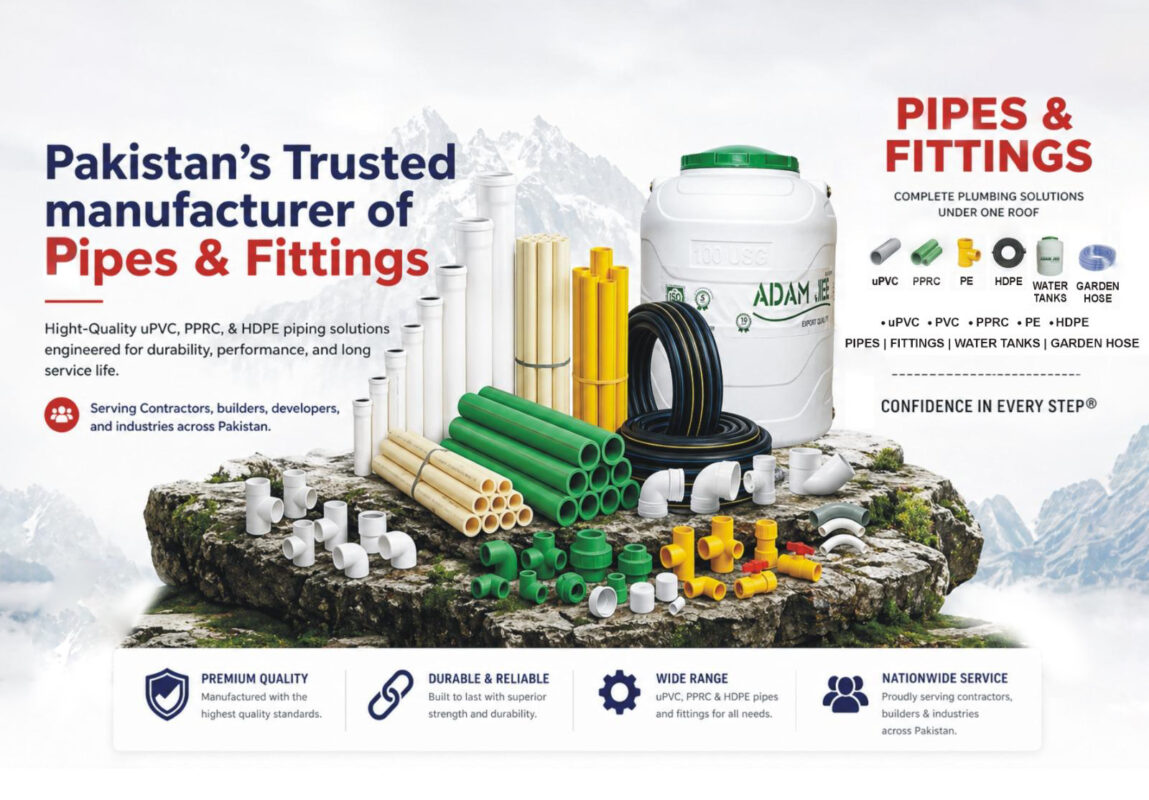
A manufacturer offering a complete range — from small-diameter agricultural pipes to large-diameter sewerage and drainage pipes, along with matching elbows, tees, and couplings — saves contractors from mixing suppliers mid-project.
5. Track Record and Local Presence
Manufacturers with an established production history and a physical facility (rather than pure traders) are generally better positioned to guarantee consistent batch quality and after-sales support.
Common Applications of PVC Pipes in Pakistan
- Residential and commercial plumbing — water supply and drainage lines in housing societies and commercial buildings.
- Agricultural irrigation — a major growth segment given Pakistan’s reliance on tube-well and canal-fed irrigation systems.
- Sewerage and drainage networks — municipal and housing-scheme sewerage lines.
- Electrical conduit — PVC conduit pipes for cable protection in construction.
- Industrial fluid transport — chemical-resistant grades used in select industrial applications.
Adamjee Plastics Industries: A Faisalabad-Based Manufacturer
Faisalabad has long been an industrial hub for Pakistan’s plastics and pipe manufacturing sector, and Adamjee Plastics Industries operates from within this base. As a manufacturer of PVC pipes and related products, Adamjee Plastics Industries serves contractors, distributors, and agricultural buyers across Punjab, with distribution extending toward Lahore, Sahiwal, and Jhang.
View our full PVC pipe product range
Learn more about Adamjee Plastics Industries
For buyers evaluating suppliers, working with a manufacturer that controls its own production — rather than a reseller — typically means more consistent quality control and better ability to fulfill large or custom orders.
How PVC Pipe Pricing Works in Pakistan
Pricing is generally determined by:
- Pipe diameter and pressure class — larger diameter and higher pressure ratings cost more per meter.
- Raw material (PVC resin) cost — since resin is largely imported, pricing can shift with international polymer prices and exchange rate movement.
- Order volume — bulk orders from contractors and distributors typically receive better per-unit pricing than retail purchases.
- Regional freight — delivery cost from the manufacturing base (e.g., Faisalabad) to the project site.
Buyers are advised to request a current rate list directly from the manufacturer rather than relying on outdated online price references, as PVC pricing tends to fluctuate.
Frequently Asked Questions
What is the difference between PVC and uPVC pipes?
uPVC (unplasticized PVC) is a rigid form of PVC without added plasticizers, commonly used for pressure and drainage pipes. Standard PVC used in Pakistan for plumbing and irrigation is generally uPVC-grade, even when marketed simply as “PVC.”
How do I verify a PVC pipe manufacturer is genuine and not just a trader?
Ask for their manufacturing facility location, PSQCA certification, and production capacity. A genuine manufacturer will be able to show you their production line or provide verifiable documentation.
What size PVC pipe is used for home water supply in Pakistan?
Residential water supply lines typically use ½ inch to 1 inch diameter pipes, while main distribution lines may use 1.5 to 2 inch, depending on building size and water pressure requirements.
Are PVC pipes suitable for hot water lines?
Standard PVC is not rated for continuous hot water use. CPVC (Chlorinated PVC) is the appropriate choice for hot water plumbing, and buyers should confirm which grade a manufacturer supplies before ordering.
How long do PVC pipes last?
When manufactured to standard specification and installed correctly, PVC pipes commonly last 25 to 50 years, making them a long-term investment for both residential and agricultural use.
Conclusion
Selecting the right PVC pipes manufacturer in Pakistan comes down to three things: verified quality standards, consistent product availability across sizes, and a supplier with genuine manufacturing capability rather than resale operations. Faisalabad-based manufacturers like Adamjee Plastics Industries combine local production with a growing distribution footprint across Punjab, making them a practical choice for contractors and distributors sourcing PVC pipes at scale.